
|
|
|
Cataract |
|
|
CONTENT LIST What are the different types of cataract? Is cataract surgery effective? When will my vision be normal again? What can you do to protect your vision?
|
This pamphlet has been written to help people with cataracts and their families better understand the condition. It
describes the symptoms, diagnosis, and treatment of cataracts.
A cataract is a clouding of the eye's lens that can cause vision problems. The most common type is related to aging. More than half of all Americans age 65 and older have a cataract. In the early stages, stronger lighting and eyeglasses may lessen vision problems caused by cataracts. At a certain point, however, surgery may be needed to improve vision. Today, cataract surgery is safe and very effective.
The lens is the part of the eye that helps focus light on the retina. The retina is the eye's light-sensitive layer that
sends visual signals to the brain. In a normal eye, light passes through the lens and gets focused on the retina. To
help produce a sharp image, the lens must remain clear.
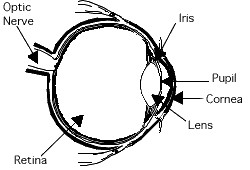
The lens is made mostly of water and protein. The protein is arranged to let light pass through and focus on the
retina. Sometimes some of the protein clumps together. This can start to cloud small areas of the lens, blocking
some light from reaching the retina and interfering with vision. This is a cataract.
In its early stages, a cataract may not cause a problem. The cloudiness may affect only a small part of the lens.
However, over time, the cataract may grow larger and cloud more of the lens, making it harder to see.
Because less light reaches the retina, your vision may become dull and blurry. A cataract won't spread from
one eye to the other, although many people develop cataracts in both eyes.
Although researchers are learning more about cataracts, no one knows for sure what causes them. Scientists
think there may be several causes, including smoking, diabetes, and excessive exposure to sunlight. |
| TOP |
What are the symptoms?
The most common symptoms of a cataract are:
When a cataract is small, you may not notice any changes in your vision. Cataracts tend to grow slowly, so
vision gets worse gradually. Some people with a cataract find that their close-up vision suddenly improves, but
this is temporary. Vision is likely to get worse again as the cataract grows.
|
| TOP |
What are the different types of cataract?
|
| TOP |
How is a cataract detected?
To detect a cataract, an eye care professional examines the lens. A comprehensive eye examination usually
includes:
|
| TOP |
How is it treated?
For an early cataract, vision may improve by using different eyeglasses, magnifying lenses, or stronger lighting.
If these measures don't help, surgery is the only effective treatment. This treatment involves removing the
cloudy lens and replacing it with a substitute lens.
A cataract needs to be removed only when vision loss interferes with your everyday activities, such as driving, reading, or watching TV. You and your eye care professional can make that decision together.
In most cases, waiting until you are ready to have cataract surgery will not harm your eye. If you decide on
surgery, your eye care professional may refer you to a specialist to remove the cataract. If you have cataracts
in both eyes, the doctor will not remove them both at the same time. You will need to have each done
separately.
Sometimes, a cataract should be removed even if it doesn't cause problems with your vision. For example, a
cataract should be removed if it prevents examination or treatment of another eye problem, such as
age-related macular degeneration or diabetic retinopathy.
|
| TOP |
Is cataract surgery effective?
Cataract removal is one of the most common operations performed in the U.S. today. It is also one of the safest and most effective. In about 90 percent of cases, people who have cataract surgery have better vision afterward.
|
| TOP |
How is a cataract removed?
There are two primary ways to remove a cataract. Your doctor can explain the differences and help determine
which is best for you:
Some people cannot have an IOL. They may have problems during surgery, or maybe they have another eye
disease. For these people, a soft contact lens may be suggested. For others, glasses that provide powerful
magnification may be better.
|
| TOP |
What happens before surgery?
A week or two before surgery, your eye care professional will do some tests. These may include tests to
measure the curve of the cornea and the size and shape of the eye. For patients who will receive an IOL, this
information helps your doctor choose the right type of IOL. Also, doctors may ask you not to eat or drink
anything after midnight the morning of your surgery.
|
| TOP |
What happens during surgery?
When you enter the hospital or clinic, you will be given eye drops to dilate the pupil. The area
around your eye will be washed and cleansed.
The operation usually lasts less than 1 hour and is almost painless. Many people choose to stay
awake during surgery, while others may need to be put to sleep for a short time. If you are awake,
you will have an anesthetic to numb the nerves in and around your eye.
After the operation, a patch will be placed over your eye and you will rest for a while. You will be
watched by your medical team to see if there are any problems, such as bleeding. Most people who
have cataract surgery can go home the same day. Since you will not be able to drive, make sure you
make arrangements for a ride.
|
| TOP |
What happens after surgery?
It's normal to feel itching and mild discomfort for a while after cataract surgery. Some fluid discharge
is also common, and your eye may be sensitive to light and touch. If you have discomfort, your eye
care professional may suggest a pain reliever every 4-6 hours. After 1-2 days, even moderate
discomfort should disappear. In most cases, healing will take about 6 weeks.
After surgery, your doctor will schedule exams to check on your progress. For a few days after
surgery, you may take eyedrops or pills to help healing and control the pressure inside your eye. Ask
your doctor how to use your medications, when to take them, and what effects they can have. You
will also need to wear an eye shield or eyeglasses to help protect the eye. Avoid rubbing or pressing
on your eye.
Problems after surgery are rare, but they can occur. These can include infection, bleeding,
inflammation (pain, redness, swelling), loss of vision, or light flashes. With prompt medical attention,
these problems usually can be treated successfully.
When you are home, try not to bend or lift heavy objects. Bending increases pressure in the eye.
You can walk, climb stairs, and do light household chores.
|
| TOP |
When will my vision be normal again?
You can quickly return to many everyday activities, but your vision may be blurry. The healing eye
needs time to adjust so that it can focus properly with the other eye, especially if the other eye has a
cataract. Ask your doctor when you can resume driving.
If you just received an IOL, you may notice that colors are very bright or have a blue tinge. Also, if
you've been in bright sunlight, everything may be reddish for a few hours. If you see these color tinges,
it is because your lens is clear and no longer cloudy. Within a few months after receiving an IOL, these
colors should go away. And when you have healed, you will probably need new glasses.
|
| TOP |
What is an "after-cataract"?
Sometimes a part of the natural lens that is not removed during cataract surgery becomes cloudy and
may blur your vision. This is called an after-cataract. An after-cataract can develop months or years
later.
Unlike a cataract, an after-cataract is treated with a laser. In a technique called YAG laser
capsulotomy, your doctor uses a laser beam to make a tiny hole in the lens to let light pass through.
This is a painless outpatient procedure.
|
| TOP |
What research is being done?
The NEI is conducting and supporting a number of studies, such as the Age-Related Eye Disease
Study (AREDS). In this nationwide clinical study, scientists are examining how cataracts develop and
what factors put people at risk for developing them. Also, they are looking at whether certain vitamation |
By: Tirdad Daei
January 2005